 nature.tv
Amazon Canopy at Dawn
As light filters through towering kapok trees, the rainforest awakens with birdsong, insects, and primates moving through the dense foliage above the forest floor.
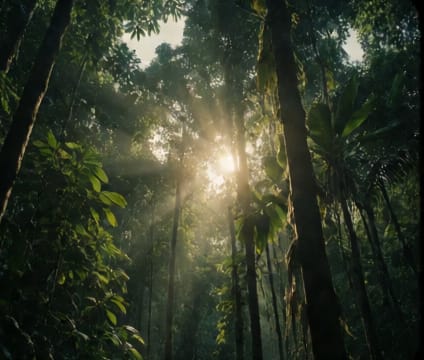
The first rays of sun gild the upper reaches of the Amazon rainforest, turning dewdrops into glittering beads on broad leaves. Marmosets and capuchins leap between branches, their movements silent and precise. Below, leafcutter ants begin their daily trails, carriying fragments of green back to sprawling underground nests. This layered world—emergent, canopy, understory, and forest floor—each hosts specialized life adapted to its light, humidity, and shelter.
Insect life surges into action as temperatures rise: orchid bees buzz among fragrant blooms, while spiders rebuild delicate webs strung between vines. Tree frogs cling to wet leaves, their sticky toe pads holding firm. The air hums with sound—the chorus of frogs, insects, and distant howler monkeys—marking the start of daily foraging and mating rituals. Predators like jaguars, though rarely seen, move with quiet intent in the dimmed understory.
Light availability shapes every aspect of canopy life. Plants compete for sun with broad leaves, buttress roots, and epiphytes like bromeliads that collect water in their rosettes. Ants and fungi co-evolve in complex mutualisms, while pollinators ensure plant reproduction. These relationships rely on precise timing and environmental cues, all coordinated as dawn’s light triggers biochemical shifts across thousands of species.
As the canopy warms, vines and lianas sway gently in the emerging breeze, creating shifting pathways for animals. Birds disperse seeds across kilometers, reinforcing forest connectivity. Canopy frogs lay eggs in tiny water-filled leaf axils, ensuring the next generation stays sheltered and fed. This rich, three-dimensional habitat exemplifies biodiversity in action, sustained by intricate ecological balances and evolutionary adaptations refined over millennia.
Key takeaways
- Most Amazon wildlife lives in the canopy, not the forest floor.
- Epiphytes and mutualisms drive canopy ecosystem function.
- Dawn triggers synchronized behavior across species.
More in Habitats
Coral Polyps in Symbiosis
Tiny soft-bodied polyps build vast reef structures through a vital partnership with microscopic algae that provides energy
Read more →
Sahara Dunes at Sunset
As light fades across rolling dunes, winds sculpt silica grains into ever-changing patterns, revealing how life endures and moves
Read more →